An American Dream in Rust
1816
June, July, August of the year 1816. The summer months passed one after another, yet the cold tightened its grip on both the land and its people. In the waterlogged fields, the crops froze. Little by little, hunger settled permanently in the stomachs of the people of Rust.
Gradually, a dream took root in the minds of a few families beneath the clouds of this year without a summer. Convinced that a better life might await them, they chose courage over despair. They gathered their few belongings and provisions into cloth bundles. Their hope? To reach America, a distant land where the winds of freedom and promise were said to blow, and begin a new life there. They knew that, nearly a century earlier, German families had emigrated to San Antonio, where they had rebuilt a German community and erected a chapel in 1718. For them, this church had gradually become the symbol of hope for a new life.
Before they could brave the Atlantic and its turbulent waters, they first had to reach the Netherlands, where they hoped to find a ship and set out in search of America. But weakened by hardship and exhausted after overcoming countless obstacles along the way, the families became stranded in Amsterdam, just as they stood on the threshold of their great departure.
Fortunately, two young Germans and recent members of the highly secretive Adventure Club of Europe, Kaspar and Eckbert Eulenstein, heard of their story and despair through the Club’s European network. In their workshop, the Voletarium near Rust, they had just completed the Volatus I, a curious wooden flying machine with canvas wings that flew like a bird. They decided to place their invention at the service of a noble cause and bring the German families back to Rust… through the skies.
Disappointed that they had been unable to reach America, yet relieved to be returning home, the families gathered their few belongings and boarded the Volatus I. Aboard the aircraft, they flew over Amsterdam and its winding canals, mysterious castles, and vast meadows. They also caught sight of the silhouette of a pink sandstone cathedral with a single tower before glimpsing a great forest with dark treetops.
Back in Rust, Paul Mack, an ingenious wagon builder and loyal friend of the Eulenstein brothers, had been informed by them about the expedition. He welcomed the families with open arms, shaken by their journey through the clouds but overjoyed to be reunited with the loved ones they had left behind in Germany. Deeply impressed by their courage and determination to pursue their dreams, Paul Mack, together with the Eulensteins, convinced the town of Rust to grant each family a plot of land so that these brave pioneers could begin a new life. These plots of land later became known as America.
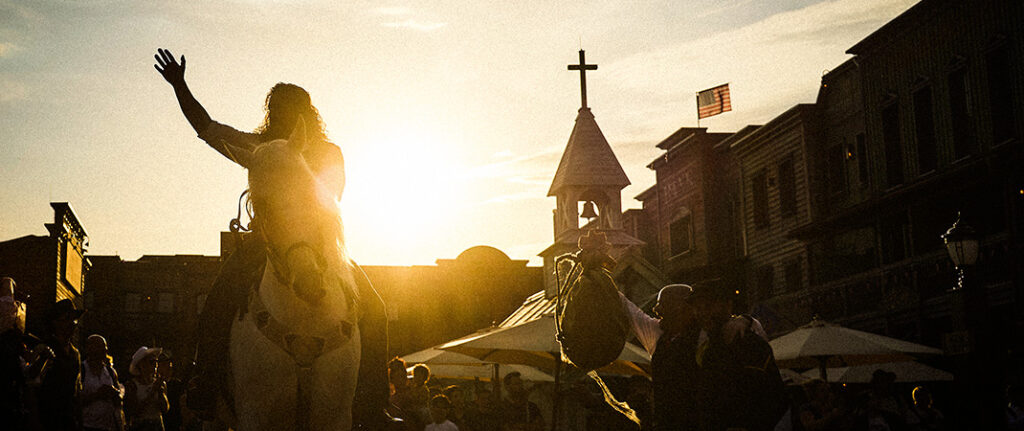
More than 200 years later, the descendants of Paul Mack have created a true piece of America in Rust with Silver Lake City. There, the Adventure Club of Europe has erected a small chapel: Chapel San Antonio 1718. Dedicated to the people of Rust who emigrated to America in 1816, it is inspired by the symbol of their unwavering hope for a better future. True to the spirit of the ACE, it celebrates the courage to pursue one’s dreams, to preserve a pioneering spirit, and the firm conviction that one must never give up, but always have the courage to start again.
Artifacts in the possession of the ACE:
- Kaspar Eulenstein’s expedition logbook
- A fragment of the Volatus I’s canvas wing
- A cloth bundle belonging to one of the families